



Understanding Water Parameters
Understanding Water Parameters
A comprehensive guide to understanding aquarium water parameters. Learn about the role of pH, GH, KH, nitrites, nitrates, and their impact on the health of fish and plants.
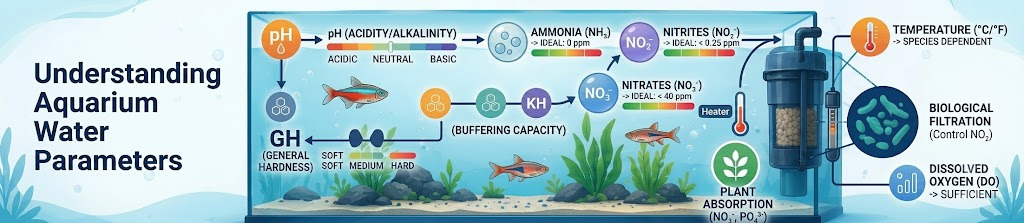
GH, KH, pH, nitrites, nitrates: Understanding All Aquarium Water Parameters
When starting in aquaristics, water parameters can seem complex. pH, GH, KH, NO₂, NO₃… these values regularly appear in water tests, but their meaning is not always obvious.
However, they play a fundamental role in the health of fish, plants, and the overall stability of the aquarium.
Understanding these parameters not only helps prevent many problems but also allows you to create an environment perfectly suited to the species you keep.
Why are water parameters so important?
In nature, each species lives in very specific conditions.
Some come from very soft and acidic rivers in South America, while others live in hard and alkaline waters.
When water parameters deviate too much from the needs of the aquarium inhabitants, several problems can arise:
- chronic stress;
- diseases;
- reproductive difficulties;
- slowed growth;
- premature mortality.
The goal is not necessarily to achieve perfect values, but rather values that are suitable and stable.
pH: Acidity or Alkalinity of Water
pH measures the level of acidity or alkalinity of water.
The scale ranges from 0 to 14:
- pH 7: neutral water;
- below 7: acidic water;
- above 7: alkaline water.
Why is pH important?
pH influences:
- the metabolism of fish;
- bacterial activity;
- plant growth;
- the toxicity of certain substances.
A sudden change in pH can cause significant shock to the aquarium inhabitants.
Common Values
| Aquarium Type | Recommended pH |
|---|---|
| Amazonian | 5.5 to 7 |
| Community | 6.5 to 7.5 |
| Guppies | 7 to 8 |
| African Cichlids | 7.5 to 8.5 |
GH: General Hardness
GH (General Hardness) measures the total amount of dissolved minerals in the water, mainly:
- calcium;
- magnesium.
Why is GH important?
GH influences:
- the growth of fish;
- reproduction;
- molting of shrimp;
- the development of plants.
Interpretation of values
| GH | Water Type |
|---|---|
| 0 to 4 | Very soft |
| 4 to 8 | Soft |
| 8 to 12 | Medium |
| 12 to 18 | Hard |
| >18 | Very hard |
Some species like Discus or Cardinalis prefer soft water, while Guppies appreciate harder water.
KH: Carbonate Hardness
KH (Carbonate Hardness) measures the concentration of carbonates and bicarbonates.
It is often described as the "buffering capacity" of water.
Why is KH important?
KH acts as a buffer.
The higher the KH:
- the more stable the pH.
The lower the KH:
- the more the pH can fluctuate rapidly.
Risks of a too low KH
A KH below 2 can lead to:
- sudden pH drops;
- biological imbalance;
- significant stress for the fish.
The Relationship Between GH, KH, and pH
These three parameters are closely related.
GH
Indicates the total amount of minerals.
KH
Indicates the water's capacity to stabilize pH.
pH
Represents the final result of many chemical balances.
In summary:
| Parameter | Function |
|---|---|
| GH | Amount of minerals |
| KH | Water stability |
| pH | Acidity or alkalinity |
Nitrites (NO₂)
Nitrites are one of the most important parameters to monitor.
They appear during the nitrogen cycle.
Why are they dangerous?
Even at low concentrations, nitrites are toxic.
They prevent the proper transport of oxygen in the fish's body.
Recommended Value
| Parameter | Ideal Value |
|---|---|
| NO₂ | 0 mg/L |
The presence of nitrites in a mature aquarium should always be taken seriously.
Nitrates (NO₃)
Nitrates are the end product of the nitrogen cycle.
They are much less dangerous than nitrites but can become problematic when they accumulate.
Effects of high levels
- algae proliferation;
- fish stress;
- weakened immune system.
Recommended Values
| Population | Recommended NO₃ |
|---|---|
| Community Aquarium | < 25 mg/L |
| Planted Aquarium | < 20 mg/L |
| Sensitive Shrimp | < 10 mg/L |
Ammonia (NH₃) and Ammonium (NH₄⁺)
These compounds appear from:
- excrement;
- uneaten food;
- organic waste.
Ammonia is extremely toxic.
In a balanced aquarium, it should be quickly transformed by the filter bacteria.
Ideal Value
| Parameter | Ideal Value |
|---|---|
| NH₃/NH₄ | 0 mg/L |
CO₂
Carbon dioxide plays an essential role in planted aquariums.
It influences:
- plant growth;
- pH;
- overall aquarium balance.
However, an excess can be dangerous for fish.
Which Parameters to Monitor Regularly?
For the majority of aquariums, it is recommended to monitor:
- temperature;
- pH;
- GH;
- KH;
- nitrites;
- nitrates.
These measurements help anticipate most problems before they become visible.
How Often to Test the Water?
New Aquarium
- several times a week.
Stabilized Aquarium
- once or twice a month.
After a Significant Change
- change in population;
- addition of equipment;
- change of decor;
- medication treatment.
Additional monitoring is recommended.
Common Mistakes
Trying to change parameters too quickly
Sudden changes are often more dangerous than a slightly imperfect value.
Not Keeping a History
A single measurement provides little information.
The evolution of parameters over weeks is often much more revealing.
Relying Solely on Observation
Clear water can hide a problem with nitrites or nitrates.
Conclusion
Water parameters are the foundation of any balanced aquarium.
pH, GH, and KH determine the chemical environment in which fish live, while nitrites, nitrates, and ammonia help assess the biological quality of the tank.
Understanding these values and tracking their evolution over time is one of the best ways to prevent problems and ensure the well-being of aquarium inhabitants.
With regular measurements and a reliable history, it becomes much easier to anticipate imbalances before they affect the health of fish or plants.