



Roots and Wood in Freshwater Aquariums
Roots and Wood in Freshwater Aquariums
Discover the different types of roots and wood that can be used in freshwater aquariums, their influence on the water, tannins, preparation, and how to choose the right wood for your aquarium.
Roots and Wood in Freshwater Aquariums: The Complete Guide
Roots and wood are essential elements in many freshwater aquariums.
They help create natural decorations, provide hiding places for fish and shrimp, and add depth to a planted aquarium.
But not all roots behave the same way in water.
Some release a lot of tannins and can color the water amber brown. Others are more discreet. Some float for several weeks while others sink quickly.
Choosing the wood, preparing it, and installing it are therefore important to achieve an aesthetic and stable aquarium.
In this guide, discover the main types of roots and wood used in aquariums, their influence on the water, how to prepare them, and the mistakes to avoid.
Why Use Roots in an Aquarium?
Roots serve several functions in an aquarium.
They notably allow to:
- create a natural decoration;
- structure the space;
- provide hiding places;
- create territories;
- serve as a support for epiphytic plants;
- provide grazing surfaces for shrimp and some fish;
- add depth to an aquascape.
A root can also become a central element of the decoration.
In a planted aquarium, for example, it allows creating a composition around which the plants are organized.
The Different Types of Wood for Aquariums
There are many varieties of wood sold for aquariums.
The most common ones are:
- Spider Wood;
- Red Moor Wood;
- Mopani;
- Mangrove;
- Driftwood;
- Cholla Wood;
- Vine root;
- various natural woods specially prepared for aquariums.
Each variety has a different shape, density, and ability to release tannins.
Spider Wood
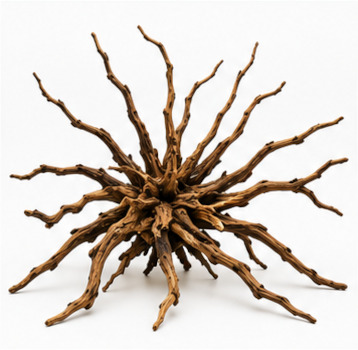
Spider Wood is a highly branched root that gets its name from its shape, which resembles the legs of a spider.
It is particularly popular in aquascaping.
Its numerous branches allow for the creation of very natural decorations and give a sense of depth to the aquarium.
Influence on the Water
| Parameter | Influence |
|---|---|
| pH | ⭐⭐☆☆☆ |
| GH | ⭐☆☆☆☆ |
| KH | ⭐☆☆☆☆ |
| Tanins | ⭐⭐⭐☆☆ |
Spider Wood can release tannins, especially when it is new.
Its influence on pH depends in particular on the KH of the water and the amount of wood used.
Advantages
- Very aesthetic.
- Highly branched.
- Excellent for aquascaping.
- Allows for attaching mosses and epiphytic plants.
- Suitable for shrimp.
Disadvantages
- Can float for a long time.
- Some branches are relatively fragile.
- The ends can be brittle.
Ideal for
- Aquascaping;
- Planted aquariums;
- Nano aquariums;
- Shrimp tanks.
Red Moor Wood
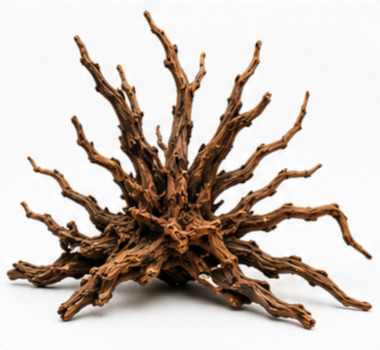
Red Moor Wood is a root highly appreciated in aquascaping.
It generally has a reddish-brown coloration and a highly branched structure.
It allows for the creation of complex and particularly natural decorations.
Influence on the Water
| Parameter | Influence |
|---|---|
| pH | ⭐⭐☆☆☆ |
| GH | ⭐☆☆☆☆ |
| KH | ⭐☆☆☆☆ |
| Tanins | ⭐⭐⭐⭐☆ |
Red Moor Wood can release a significant amount of tannins when it is new.
Advantages
- Very natural shapes.
- Excellent for complex compositions.
- Numerous branches.
- Compatible with epiphytic plants.
Disadvantages
- Can float.
- Can release a lot of tannins initially.
- Structure sometimes fragile.
Ideal for
- Aquascaping;
- Heavily planted aquariums;
- Shrimp aquariums.
Mopani
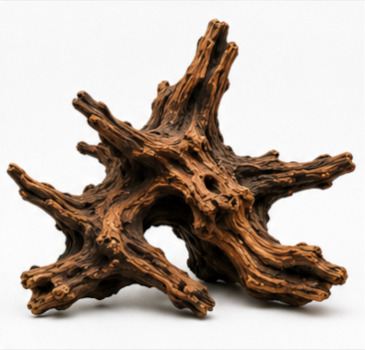
Mopani Wood is a dense and relatively heavy wood.
It is recognizable by its contrast between light and dark areas.
Its density often allows it to sink more quickly than lighter roots.
Influence on the Water
| Parameter | Influence |
|---|---|
| pH | ⭐⭐⭐☆☆ |
| GH | ⭐☆☆☆☆ |
| KH | ⭐☆☆☆☆ |
| Tanins | ⭐⭐⭐⭐☆ |
Mopani Wood can release a lot of tannins during the first few weeks.
Advantages
- Dense.
- Very natural appearance.
- Original shapes.
- Often easier to keep at the bottom.
Disadvantages
- Can strongly color the water.
- Relatively heavy.
- Some pieces may have brittle parts.
Ideal for
- Community aquariums;
- Amazonian aquariums;
- Large aquariums;
- Bottom-dwelling fish aquariums.
Mangrove
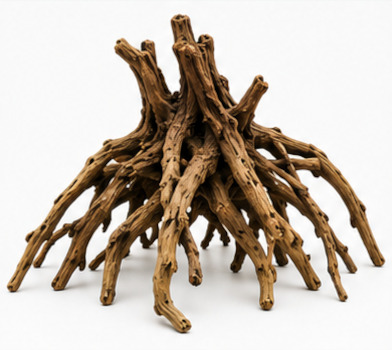
Mangrove Wood is appreciated for its natural appearance and twisted shapes.
It can be used to create landscapes reminiscent of the natural environments of tropical fish.
Influence on the Water
| Parameter | Influence |
|---|---|
| pH | ⭐⭐⭐☆☆ |
| GH | ⭐☆☆☆☆ |
| KH | ⭐☆☆☆☆ |
| Tanins | ⭐⭐⭐⭐☆ |
Like many natural woods, mangrove can release tannins into the water.
Advantages
- Natural appearance.
- Good density.
- Very varied shapes.
- Suitable for large decorations.
Disadvantages
- Can strongly color the water.
- Some pieces require a long soaking.
Driftwood
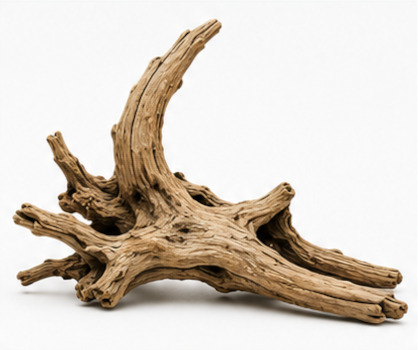
The term Driftwood generally refers to wood that has been naturally eroded by water.
Its aged appearance allows for the creation of particularly natural decorations.
The shapes vary greatly depending on the origin of the wood.
Influence on the Water
| Parameter | Influence |
|---|---|
| pH | ⭐⭐☆☆☆ |
| GH | ⭐☆☆☆☆ |
| KH | ⭐☆☆☆☆ |
| Tanins | ⭐⭐☆☆☆ |
The influence varies greatly depending on the origin and preparation of the wood.
Advantages
- Natural appearance.
- Numerous shapes available.
- Ideal for biotope-type decorations.
Disadvantages
- Variable characteristics.
- Possible flotation.
- Requires appropriate preparation.
Cholla Wood
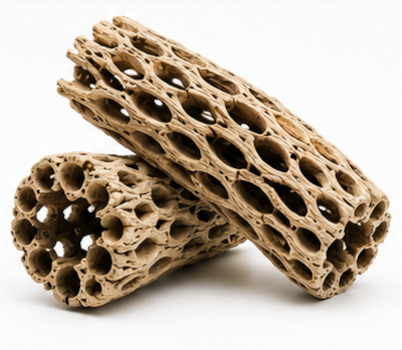
Cholla Wood comes from the dried skeleton of certain cactus species.
It has a very particular tubular structure with many cavities.
This form is particularly appreciated in shrimp aquariums.
Influence on the Water
| Parameter | Influence |
|---|---|
| pH | ⭐⭐☆☆☆ |
| GH | ⭐☆☆☆☆ |
| KH | ⭐☆☆☆☆ |
| Tanins | ⭐⭐☆☆☆ |
Advantages
- Very light.
- Many cavities.
- Excellent refuge for shrimp.
- Allows microorganisms to develop on its surface.
Disadvantages
- Gradually degrades.
- Not suitable for very large aquariums.
- Can be relatively fragile.
Ideal for
- Shrimp;
- Nano aquariums;
- Small fish;
- Natural aquariums;
Vine Root
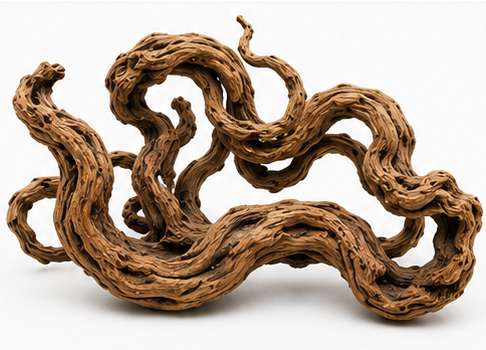
Vine root has twisted and very original shapes.
It may seem particularly interesting for creating complex decorations.
However, not all vine roots are suitable for prolonged immersion.
It is therefore important to use only wood sold and prepared specifically for aquariums.
Influence on the Water
| Parameter | Influence |
|---|---|
| pH | ⭐⭐☆☆☆ |
| GH | ⭐☆☆☆☆ |
| KH | ⭐☆☆☆☆ |
| Tanins | ⭐⭐☆☆☆ |
Advantages
- Original shapes.
- Very decorative.
- Good for natural compositions.
Disadvantages
- Variable quality.
- May degrade if the wood is not properly prepared.
- To be avoided when it comes directly from untreated vine.
Wood Found in Nature
It is possible to find pieces of wood in nature that seem perfectly suitable for an aquarium.
However, this practice requires a lot of precautions.
The wood may have been exposed to:
- pesticides;
- hydrocarbons;
- chemicals;
- environmental pollutants.
It may also contain resinous parts or be in the process of decomposition.
For this reason, using wood sold specifically for aquariums remains the safest solution.
Influence of Wood on Water Parameters
One of the main questions regarding roots is their influence on the water chemistry.
Unlike limestone rocks, wood generally does not provide large amounts of calcium or magnesium.
Its main effect rather concerns the organic matter it releases into the water.
Tannins
Tannins are organic compounds naturally present in many plants, especially in wood.
When a root is immersed, it can gradually release these compounds.
The water then takes on a coloration:
- yellow ;
- amber ;
- sometimes brownish.
This coloration is particularly visible in the first few weeks.
Are Tannins Dangerous?
At the concentrations generally encountered with wood intended for aquariums, tannins are not considered a problem for the majority of freshwater fish.
On the contrary, they are naturally present in many aquatic environments.
The black waters of South America, for example, naturally contain a significant amount of organic matter from vegetation.
Tannins can also contribute to a slight acidification of the water when conditions allow.
Does Wood Lower the pH?
Yes, but it should be nuanced.
A root can contribute to a decrease in pH by releasing acidic organic compounds.
However, the effect strongly depends on the initial chemistry of the water.
An aquarium with a high KH will be more resistant to this acidification.
Conversely, very soft water with a low KH can be much more sensitive.
Therefore, a root should not be considered a reliable means of modifying the pH.
Monitoring the parameters remains essential.
Does Wood Affect the GH?
In the majority of situations, wood does not have a significant influence on the GH.
It should therefore not be considered a means of remineralizing or demineralizing the water.
Does Wood Affect the KH?
Wood generally does not increase the KH.
However, the released organic compounds can contribute to a gradual acidification of the water and thus to a consumption of the buffering capacity under certain conditions.
Why Does the Water Turn Amber?
The amber coloration is mainly due to tannins and other organic matter released by the wood.
The intensity depends in particular on:
- the type of wood ;
- its size ;
- its age ;
- soaking time ;
- the amount of wood used.
The larger the amount of wood, the more visible the coloration can be.
How to Reduce Water Coloration?
If you appreciate the natural look of amber water, no intervention is necessary.
If you want to maintain clear water, several solutions exist.
Soak the Wood
A prolonged soak before installation helps to remove some of the soluble compounds.
Perform Water Changes
Regular water changes help to gradually reduce the concentration of tannins.
Use Activated Carbon
Activated carbon can remove some of the organic compounds responsible for the coloration.
However, it should be used in a targeted manner rather than permanently in all aquariums.
How to Prepare a Root Before Placing It in the Aquarium?
Proper preparation helps to remove impurities and limit problems during installation.
1. Rinse the Root
Start by thoroughly rinsing the wood with clear water.
Remove:
- dust;
- soil;
- loose particles;
- small debris.
2. Brush the Wood
Use a clean brush to remove any loose surface material.
Never use household cleaners or detergents.
3. Soak the Root
Soaking is particularly useful for:
- reducing water coloration;
- gradually saturating the wood;
- facilitating its immersion.
Depending on the type of wood, this step can take from a few days to several weeks.
4. Boil the Wood
Small pieces can be boiled to accelerate their saturation with water and to remove some of the soluble compounds.
However, this method is not suitable for all roots.
Large pieces can be difficult to handle, and some fragile woods may deteriorate.
5. Check for Fragile Parts
Before placing the root in the aquarium, remove any parts that come off easily.
A healthy piece of wood should remain sufficiently solid.
Why Does a Root Float?
A root floats simply because its fibers still contain air.
This is particularly common with light and highly branched woods.
Over time, water gradually penetrates the fibers.
The root then usually sinks naturally.
How to Make a Root Sink?
Several solutions are possible.
Prolonged Soaking
This is the simplest method.
Use Stones
A stone can be used temporarily to keep the root at the bottom.
Fix the Root
The root can be fixed onto a suitable stone or plate.
The fixation must be strong enough and pose no danger to the fish.
How Long Does It Take for a Root to Sink?
There is no universal duration.
Depending on the wood, it can take:
- a few days;
- several weeks;
- sometimes longer.
The density and size of the root play an important role.
A very light and highly branched root will generally take longer than a dense wood.
Why Does a Root Develop White Mold?
It is common to see a white, cottony substance on a newly placed root.
These are usually microorganisms that grow by using the organic matter present on the wood.
This appearance is particularly common on recently submerged woods.
Is It Dangerous for Fish?
In most cases, this white substance is not dangerous.
It usually gradually disappears when the microorganisms that compose it are consumed or when the available organic matter decreases.
Some species of fish and shrimp may also consume it.
How to Remove the Mold?
Several methods are possible:
- remove it manually;
- siphon the deposits;
- lightly brush the root;
- perform regular water changes.
It is generally not necessary to remove the root from the aquarium.
Which Wood to Choose According to Your Aquarium?
The choice depends both on the desired appearance and the characteristics of the aquarium.
| Type of Aquarium | Recommended Woods |
|---|---|
| Amazonian Aquarium | Mopani, Mangrove, Driftwood |
| Aquascaping | Spider Wood, Red Moor Wood |
| Planted Aquarium | Spider Wood, Red Moor Wood, Driftwood |
| Shrimp Aquarium | Cholla Wood, Spider Wood, Red Moor Wood |
| Nano Aquarium | Spider Wood, Cholla Wood |
| Large Aquarium | Mopani, Mangrove, Driftwood |
Roots and Plants
Roots are excellent supports for certain plants.
Epiphytic plants can be attached directly to the wood.
Among the most popular:
- Anubias;
- Microsorum;
- Bucephalandra;
- aquatic mosses.
The rhizome of these plants should generally not be buried.
It can be attached to the root using:
- a wire;
- a fishing line;
- a cyanoacrylate glue suitable for aquariums.
Over time, the plant's roots naturally attach to the wood.
The Most Common Mistakes
Introducing an Unprepared Wood
A poorly cleaned root can introduce impurities into the aquarium.
Using Treated Wood
Woods that are:
- varnished ;
- painted ;
- chemically treated ;
- impregnated ;
should never be introduced into an aquarium.
Collecting Any Wood from Nature
A piece of wood found in the forest or near a watercourse may contain undesirable substances.
Its origin must be perfectly known.
Removing White Mold Immediately
The presence of this substance is generally temporary.
It does not necessarily mean that the root is dangerous.
Adding a Very Large Amount of Wood at Once
A large amount of wood can release a lot of organic matter and strongly color the water.
It is better to anticipate this effect.
Comparative Table of Common Woods
| Wood | pH Influence | GH | KH | Tannins | Floats Initially | Aquascaping | Shrimp |
|---|---|---|---|---|---|---|---|
| Spider Wood | ⭐⭐☆☆☆ | ⭐☆☆☆☆ | ⭐☆☆☆☆ | ⭐⭐⭐☆☆ | Yes | ⭐⭐⭐⭐⭐ | ⭐⭐⭐⭐⭐ |
| Red Moor Wood | ⭐⭐☆☆☆ | ⭐☆☆☆☆ | ⭐☆☆☆☆ | ⭐⭐⭐⭐☆ | Yes | ⭐⭐⭐⭐⭐ | ⭐⭐⭐⭐⭐ |
| Mopani | ⭐⭐⭐☆☆ | ⭐☆☆☆☆ | ⭐☆☆☆☆ | ⭐⭐⭐⭐☆ | Rarely | ⭐⭐⭐⭐☆ | ⭐⭐⭐⭐☆ |
| Mangrove | ⭐⭐⭐☆☆ | ⭐☆☆☆☆ | ⭐☆☆☆☆ | ⭐⭐⭐⭐☆ | Sometimes | ⭐⭐⭐⭐☆ | ⭐⭐⭐⭐☆ |
| Driftwood | ⭐⭐☆☆☆ | ⭐☆☆☆☆ | ⭐☆☆☆☆ | ⭐⭐☆☆☆ | Variable | ⭐⭐⭐⭐☆ | ⭐⭐⭐⭐☆ |
| Cholla Wood | ⭐⭐☆☆☆ | ⭐☆☆☆☆ | ⭐☆☆☆☆ | ⭐⭐☆☆☆ | Yes | ⭐⭐⭐☆☆ | ⭐⭐⭐⭐⭐ |
| Vine Root | ⭐⭐☆☆☆ | ⭐☆☆☆☆ | ⭐☆☆☆☆ | ⭐⭐☆☆☆ | Yes | ⭐⭐⭐⭐☆ | ⭐⭐⭐⭐☆ |
Note: The effects of wood on pH and water coloration vary depending on the amount used, the type of wood, and the characteristics of the water. These indications are therefore general trends and not absolute values.
Which Wood to Choose for Beginners?
If you are a beginner, opt for wood sold specifically for aquariums.
For a planted aquarium or an aquascape, Spider Wood and Red Moor Wood are particularly interesting due to their numerous branches.
For an aquarium requiring dense and imposing wood, Mopani or certain Driftwood may be more suitable.
For a shrimp aquarium, Cholla Wood is an interesting option due to its numerous cavities.
Frequently Asked Questions
Does a Root Lower the pH?
It can contribute to a slight decrease in pH due to the organic compounds it releases, but the effect strongly depends on the KH and the composition of the water.
A root should therefore not be used as the sole method to modify the pH.
Are Tannins Dangerous for Fish?
In the concentrations generally produced by woods intended for aquariums, tannins are generally not problematic for freshwater fish.
Some species naturally live in waters rich in organic matter and tannins.
Why Does My Water Turn Brown After Adding a Root?
The coloration mainly comes from the tannins released by the wood.
It generally gradually decreases over time.
Water changes and activated carbon can accelerate the disappearance of this coloration.
How Long Should a Root Be Soaked?
There is no universal duration.
A few days may be sufficient for some woods, while others require several weeks.
Soaking is complete when the wood is sufficiently waterlogged and the coloration produced corresponds to what you want to achieve.
Does a Root Have to Sink?
No.
Some roots float for several weeks before being completely saturated with water.
It is possible to temporarily keep them down with a stone or suitable fixture.
Can I Boil All Roots?
Non.
The possibility of boiling a root mainly depends on its size and strength.
For large pieces or fragile woods, cleaning and prolonged soaking are generally more suitable.
Why Does a Root Turn White?
A white, cottony substance may appear on a recently introduced root.
These are generally microorganisms that develop on the organic matter of the wood.
The phenomenon is generally temporary.
Can I Put a Root Found in the Forest in My Aquarium?
It is not recommended without knowing its origin and composition precisely.
Wood found in nature may have been exposed to pesticides, hydrocarbons, or other contaminants.
Woods prepared for aquariums are a safer solution.
Can Multiple Types of Wood Be Placed in the Same Aquarium?
Yes.
It is perfectly possible to combine several types of wood.
However, you must take into account:
- their size;
- their density;
- the total quantity used;
- the coloration they may produce.
Are Roots Useful for Shrimp?
Yes.
The surfaces of the roots can host microorganisms and biofilm, which shrimp particularly enjoy.
Highly branched structures also provide numerous hiding places.
Conclusion
Roots and woods can completely transform the appearance of a freshwater aquarium.
They add relief, create hiding places, and allow for the reproduction of particularly convincing natural environments.
Their influence on the water is generally different from that of limestone rocks. Their main effect concerns the release of tannins and organic matter, which can notably give the water an amber coloration and contribute to slight acidification under certain conditions.
The choice of wood must therefore depend on both the desired aesthetics, the fish kept, and the characteristics of the water.
Before introducing a root, take the time to clean it, brush it, and, if necessary, soak it long enough.
With properly prepared wood suited to your aquarium, roots become both a major decorative element and a particularly interesting support for creating a natural and balanced environment.