



Reproduction of Freshwater Fish
Reproduction of Freshwater Fish
Learn how to breed freshwater fish in an aquarium, prepare a breeding tank, protect the eggs, and successfully raise the fry.
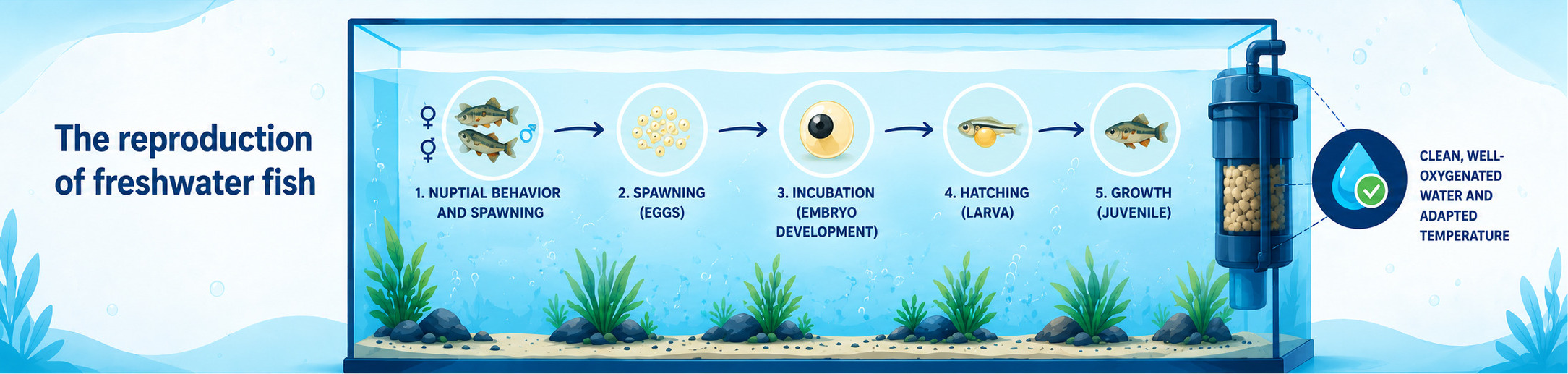
Reproduction of Freshwater Fish: A Complete Guide to Successfully Raising Your First Fry
Observing the birth and growth of young fish is one of the most fascinating experiences in aquaristics.
However, breeding in an aquarium is not just about bringing a male and a female together. Each species has its own behaviors, requirements, and breeding strategies.
In this guide, learn how to promote the reproduction of freshwater fish, protect the eggs, and provide the best conditions for the future fry.
Why Breed Your Fish?
Breeding offers several advantages:
- observing fascinating natural behaviors;
- preserving certain species;
- developing your knowledge in aquaristics;
- creating a population from your own breeding.
However, it requires more rigor than a typical community aquarium.
Understanding Different Breeding Methods
Not all fish reproduce in the same way.
Oviparous Fish
Oviparous fish lay eggs that are then fertilized.
This is the case for many species:
- Neon Tetras;
- Danios;
- Corydoras;
- Angelfish;
- Killifish.
Depending on the species, the eggs can be:
- laid on plants;
- attached to decorations;
- buried in the substrate;
- protected by the parents.
Ovoviviparous Fish
In ovoviviparous fish, the eggs develop inside the female.
The fry are born fully formed.
Examples:
- Guppy;
- Molly;
- Platy;
- Swordtail.
These are often the easiest species to breed for beginners.
Bubble Nest Builders
Some species build a bubble nest.
The most well-known case is:
- Betta splendens.
The male builds a nest on the surface and then protects the eggs after spawning.
Favorable Conditions for Reproduction
Several factors must be met to trigger reproduction.
Suitable Water
The parameters must match the species' needs:
- temperature;
- pH;
- GH;
- KH.
Some species only reproduce in very soft water, while others prefer harder water.
Quality Food
A rich diet often stimulates reproduction.
Before the spawning period, it is advisable to offer:
- frozen food;
- brine shrimp;
- bloodworms;
- live food when possible.
A Reassuring Environment
Fish must feel safe.
It is recommended to provide:
- hiding places;
- plants;
- moderate lighting;
- minimal external disturbances.
How to Recognize a Female Ready to Spawn?
Signs vary depending on the species, but some behaviors are common:
- larger abdomen;
- more pronounced colors;
- increased activity;
- courtship behaviors.
In viviparous species like Guppies, the female often shows a more visible gravid spot.
Breeding Tank
Some breeding can take place in the main aquarium.
However, a dedicated tank significantly increases the chances of success.
Why Use a Dedicated Tank?
It allows:
- protecting the eggs;
- limiting predation;
- controlling the parameters;
- facilitating the rearing of fry.
Recommended Features
- volume of 20 to 60 liters;
- gentle filtration;
- stable heating;
- plenty of hiding places;
- moderate lighting.
Air-driven sponge filters are particularly suitable for breeding tanks.
Spawning Process
Courtship Behaviors
Before spawning, fish often exhibit specific behaviors:
- chases;
- color displays;
- courtship dances;
- cleaning a spawning area.
Spawning
Depending on the species:
- several dozen;
- several hundred;
- sometimes several thousand eggs can be produced.
After Spawning
Parental behaviors vary greatly.
Some species:
- protect the eggs;
- fan the eggs;
- move the larvae.
Others eat their own eggs immediately.
Should the Parents Be Separated?
It entirely depends on the species.
Species to Separate
For example:
- Guppies;
- Platys;
- Danios.
Parents may consume the eggs or fry.
Protective Species
For example:
- Angelfish;
- some Dwarf Cichlids;
- Bettas (male only).
Parents actively participate in protecting the eggs.
Egg Incubation
The duration varies depending on:
- the species;
- the temperature;
- the water parameters.
Some examples:
| Species | Incubation |
|---|---|
| Betta | 24 to 48 h |
| Corydoras | 3 to 5 days |
| Angelfish | 2 to 4 days |
| Killifish | Variable depending on the species |
During this period, it is important to limit handling.
The First Days of Fry
After hatching, the young fish generally consume their yolk sac.
They do not require any additional feeding at this stage.
When free swimming begins, feeding should start.
Feeding the Fry
The food must be appropriate for their size.
Depending on the species:
- infusoria;
- micro worms;
- Artemia nauplii;
- special fry food.
The frequency is important.
It is often better to distribute:
- several small meals;
- rather than a single large meal.
Water Changes
Fry are particularly sensitive to water quality.
Small, regular water changes help to:
- remove waste;
- promote growth;
- limit diseases.
Changes should be made carefully to avoid any shock.
Common Mistakes
Attempting to breed fish without preparation
Each species has specific needs.
Neglecting water quality
Poor water quality significantly reduces the chances of success.
Using overly powerful filtration
Young fish can be sucked into the filter.
Overfeeding
Pollution increases rapidly in breeding tanks.
Not anticipating the number of young
Some species produce several dozen fry with each reproduction.
It is important to plan for their future housing.
The Easiest Species for Beginners
If you want to discover breeding in an aquarium, these species are particularly suitable:
Guppy
- very frequent reproduction ;
- relatively robust fry ;
- ideal for beginners.
Platy
- similar to Guppy ;
- fast growth.
Corydoras
- easy to observe spawning ;
- interesting behavior.
Betta splendens
- more technical reproduction ;
- very rewarding to observe.
Why Track Reproductions ?
When you start breeding multiple species, it quickly becomes difficult to remember :
- spawning dates ;
- parameters used ;
- hatching dates ;
- number of fry obtained.
Keeping a record allows you to identify the conditions that favor the best success and gradually improve your results.
Conclusion
Breeding freshwater fish is an exciting experience that allows you to discover a often overlooked aspect of aquarism. By respecting the needs of each species, maintaining excellent water quality, and properly preparing the breeding tank, it is possible to achieve very good results even as a beginner.
By respecting the needs of each species, maintaining excellent water quality, and properly preparing the breeding tank, it is possible to achieve very good results even as a beginner.
Patience, observation, and regular monitoring remain the best keys to success.