



Remove Algae in an Aquarium?
Remove Algae in an Aquarium?
Discover why algae appear in an aquarium, how to identify their origin, and what solutions to implement to restore a healthy and balanced tank.
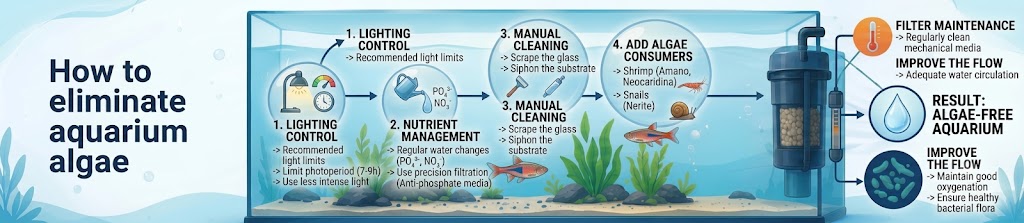
How to Remove Algae in an Aquarium? Understanding the Causes and Restoring Balance
The appearance of algae is one of the most common problems faced by aquarists.
Whether you are a beginner or have several years of experience, it is common to see green deposits on the glass, filaments on the plants, or algae invading the decor.
The good news is that algae are not a disease.
They are usually a symptom of an imbalance in the aquarium.
Understanding their origin is often the key to eliminating them permanently.
Are algae always a problem?
Contrary to popular belief, the presence of a small amount of algae is perfectly normal.
In nature as in an aquarium, they are part of the ecosystem.
The problem arises when their growth becomes uncontrollable.
Algae then begin to:
- cover the glass;
- suffocate the plants;
- degrade the aesthetics of the tank;
- compete with the vegetation.
Why do algae appear?
Algae usually take advantage of an imbalance between:
- light;
- nutrients;
- plants;
- tank stability.
When one of these elements becomes excessive or insufficient, algae find an opportunity to develop.
First Cause: Excessive Lighting
This is one of the most common causes.
Too much or too long lighting promotes algae photosynthesis.
Characteristic Signs
- green glass;
- rapid appearance after cleaning;
- algae concentrated in the most illuminated areas.
What to Do?
For most aquariums:
- 7 to 9 hours of lighting per day is sufficient;
- avoid direct sunlight;
- use a timer.
Second Cause: High Nitrate Levels
Nitrates are a source of nutrients for algae.
When their concentration continuously increases, algae have a significant reserve to develop.
Common Causes
- insufficient water changes;
- overpopulation;
- excessive feeding;
- lack of plants.
Regular monitoring of nitrate levels often allows the problem to be detected before algae appear.
Third Cause: A Sparsely Planted Aquarium
Plants and algae compete for the same resources.
In a heavily planted aquarium:
- plants consume the nutrients;
- algae have fewer resources.
In a sparsely planted aquarium, the situation is reversed.
Particularly Effective Plants
- Hygrophila ;
- Limnophila ;
- Ceratophyllum ;
- Vallisneria.
Fourth Cause: A Young Aquarium
Algae often appear during the first few weeks after setting up the aquarium.
This is generally a normal stage.
The ecosystem is still unstable:
- bacteria are not fully established;
- plants are adapting;
- parameters are evolving.
In most cases, the problem naturally decreases over time.
Fifth Cause: Accumulation of Waste
Organic waste decomposes and enriches the water.
This includes:
- leftover food ;
- dead leaves ;
- deposits in the substrate ;
- poorly circulated areas.
Regular maintenance helps limit this accumulation.
Identifying the Main Types of Algae
Green Algae
The most common.
They usually appear on:
- the glass;
- decorations;
- some leaves.
Their presence is often linked to an excess of light or nutrients.
Filamentous Algae
They form long green threads.
They frequently appear in new or unbalanced aquariums.
Brush Algae
Small black or dark gray tufts.
They are often associated with:
- poor circulation;
- CO₂ instability;
- prolonged imbalance.
Cyanobacteria
Often confused with algae.
They form a slimy layer:
- green;
- bluish;
- sometimes brownish.
Their appearance is generally linked to a significant imbalance.
How to Remove Algae Permanently?
Manually Remove as Much as Possible
Always start by:
- cleaning the glass;
- removing heavily affected leaves;
- siphoning deposits.
Reduce the Cause of the Problem
Permanent removal always involves identifying the source.
Without correcting the imbalance:
- algae will quickly return.
Increase Plant Competition
Adding more plants is often one of the most effective solutions.
Perform Regular Water Changes
They help reduce:
- nitrates;
- phosphates;
- dissolved waste.
Common Mistakes
Using Only Algae Control Products
These products often treat the symptoms but rarely the cause.
Reducing Light Abruptly
Plants can also suffer from this.
Ignoring Water Parameters
Nitrates, pH, and other parameters often provide the key to the problem.
Over-Cleaning the Filter
Aggressive cleaning can disrupt the biological balance of the aquarium.
How to Prevent Algae from Returning?
Some good practices can help prevent most invasions:
- controlled lighting;
- regular water changes;
- sufficient planting;
- appropriate population;
- monitoring parameters;
- regular maintenance.
The goal is not to have a completely algae-free aquarium, but an aquarium balanced enough to keep their growth limited.
Conclusion
Algae are rarely the real problem.
They are primarily an indicator of an imbalance in the aquarium.
Rather than trying to eliminate them at all costs, it is generally more effective to identify the cause of their appearance: excess light, nitrate accumulation, lack of plants, or insufficient maintenance.
With regular monitoring of parameters and some targeted adjustments, it is possible to achieve a healthy, stable, and visually pleasing aquarium.