

Setting Up a New Aquarium
Setting Up a New Aquarium
Learn all the steps to set up a new aquarium: installation, water filling, nitrogen cycle, planting, and gradual introduction of fish.
Setting Up a New Aquarium: A Complete Guide for Beginners
Setting up a new aquarium is an exciting step. However, many beginners make mistakes in the first few days, which can lead to algae problems, nitrite spikes, or even the loss of the first fish.
The success of an aquarium relies primarily on good preparation and following a few essential steps.
In this guide, learn how to set up a new aquarium to create a stable and sustainable environment for your future inhabitants.
Choosing the Aquarium Location
Before even installing the equipment, it is important to choose a suitable location.
The aquarium should be placed:
- on a stand capable of supporting its weight ;
- away from direct sunlight ;
- away from heat sources ;
- near an electrical outlet ;
- in a location where it can be easily observed.
A 100-liter aquarium often weighs more than 120 kg when filled.
Installing the Equipment
Before filling the aquarium with water, make sure all the equipment is ready.
The Filter
The filter is one of the most important components.
It provides:
- mechanical filtration ;
- biological filtration ;
- water circulation.
The Heater
For tropical aquariums, the temperature is usually between 24 and 26°C.
The Lighting
Lighting promotes plant growth and contributes to the overall balance of the tank.
Preparing the Substrate
The choice of substrate depends on the type of aquarium.
Planted Aquarium
For a heavily planted aquarium, a technical or nutrient-rich substrate can be used.
Community Aquarium
A suitable sand or gravel will work perfectly.
Before use, rinse the substrate thoroughly to remove dust.
Installing the Decor
Roots, stones, and other decorative elements should be installed before filling the aquarium.
Make sure to use only materials compatible with aquariums.
Decor allows you to:
- create hiding places ;
- reduce fish stress ;
- improve the tank's aesthetics.
Planting the Aquarium
Plants play an essential role from the start.
They help to:
- absorb certain nitrogen compounds ;
- limit algae ;
- oxygenate the water ;
- stabilize the ecosystem.
To start, choose easy-to-care-for species:
- Anubias ;
- Cryptocoryne ;
- Vallisneria ;
- Microsorum ;
- Hygrophila.
Filling the Aquarium
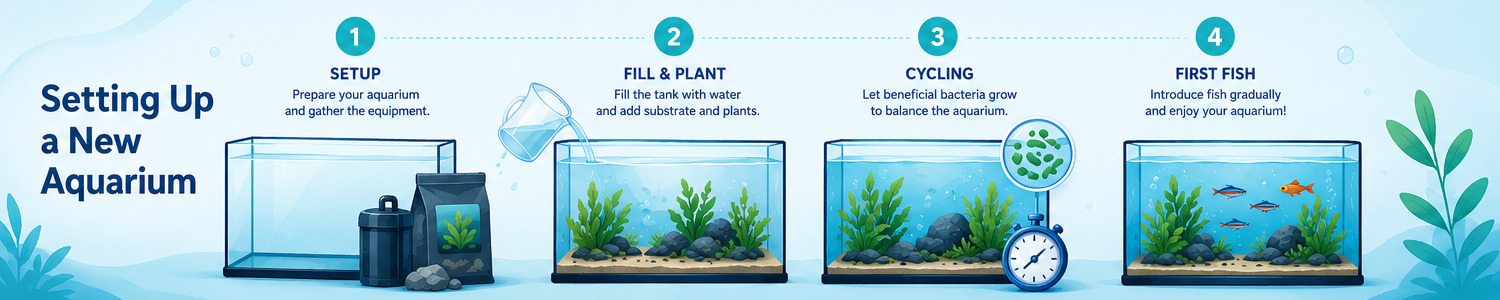
Filling should be done slowly to avoid disturbing the substrate.
One tip is to pour the water over a plate or plastic bag placed on the substrate.
Once the aquarium is filled:
- start the filter ;
- turn on the heater ;
- check for leaks.
Understanding the Nitrogen Cycle
After filling the aquarium, a crucial step begins: the nitrogen cycle.
For several weeks, beneficial bacteria will colonize the filter and the surfaces of the tank.
They will help to transform:
- ammonia ;
- nitrites ;
- then nitrates.
This phase is essential before introducing the first fish.
For more information, see our complete guide on the nitrogen cycle.
How long to wait before adding fish?
In most cases, it is recommended to wait between 3 and 6 weeks.
Early introduction of fish is one of the main causes of failure for beginners.
During this period:
- monitor nitrites ;
- observe the aquarium's progress ;
- let the system stabilize.
Testing Water Parameters
The parameters to monitor are:
- pH ;
- GH ;
- KH ;
- nitrites (NO₂) ;
- nitrates (NO₃).
These measurements help ensure that the aquarium is developing correctly.
Introducing Fish Gradually
Once the cycle is complete:
- Introduce a small population.
- Wait a few days.
- Check the parameters.
- Gradually add the other inhabitants.
This method allows the bacteria to adapt to the increased biological load.
Common Mistakes
Adding too many fish at the beginning
The population should increase gradually.
Overfeeding
Uneaten food generates unnecessary pollution.
Cleaning the filter too early
The filter houses the bacteria responsible for the biological balance.
Constantly modifying the aquarium
A new aquarium needs stability to develop correctly.
Startup Checklist
Before adding the first fish, check:
- Aquarium installed on a suitable stand
- Filter running
- Heater set correctly
- Plants installed
- Nitrogen cycle completed
- Nitrites at zero
- Parameters checked
Conclusion
Starting a new aquarium requires a bit of patience, but this phase determines the long-term success of the project.
By taking the time to properly install the equipment, plant the tank, and allow the nitrogen cycle to establish, you maximize your chances of achieving a stable, aesthetically pleasing, and enjoyable aquarium.
A few weeks of waiting at the start often prevent months of problems later.