

Nitrogen Cycle in Aquarium
Nitrogen Cycle in Aquarium
Learn how the nitrogen cycle works, why it is essential for starting an aquarium, and how to avoid mistakes that endanger your fish.
Complete Guide to the Nitrogen Cycle in Aquarium
The nitrogen cycle is one of the most important concepts in aquaristics. However, it is also one of the most misunderstood topics by beginners.
Every year, many fish die because they are introduced into an aquarium that has not yet completed its biological cycle.
Understanding the nitrogen cycle allows you to start an aquarium correctly, avoid nitrite spikes, and maintain a healthy environment for fish, shrimp, and plants.
What is the Nitrogen Cycle?
In an aquarium, organic waste is produced continuously:
- fish excrement;
- uneaten food;
- dead plant leaves;
- decomposing organisms.
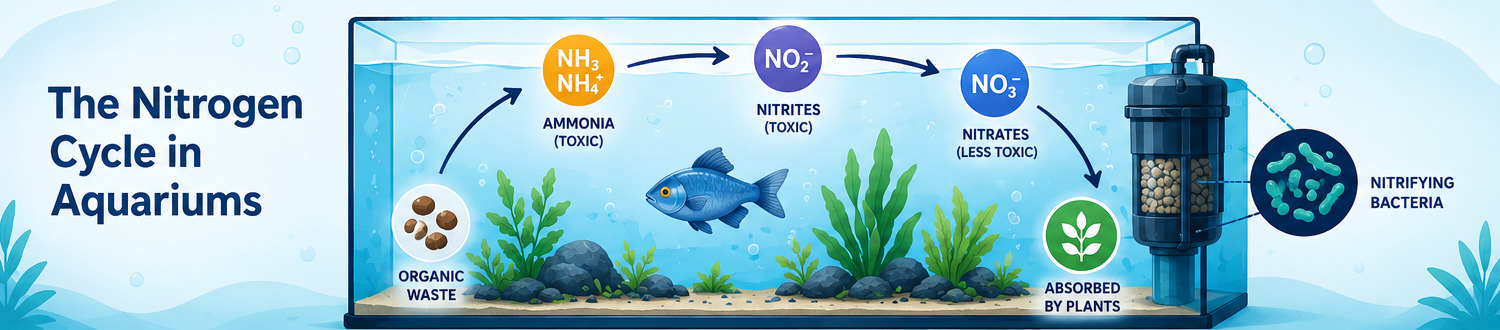
These wastes release ammonia (NH₃) or ammonium (NH₄⁺), substances that are highly toxic to aquarium inhabitants.
Fortunately, beneficial bacteria gradually colonize the filter, substrate, and various surfaces of the tank.
These bacteria transform the toxic substances into much less harmful compounds.
This natural process is called the nitrogen cycle.
The Different Stages of the Nitrogen Cycle
Stage 1: Ammonia Production
Organic waste produces ammonia.
Even at low concentrations, this substance can be deadly for fish.
In a newly set up aquarium, no bacteria are yet present to process this pollution.
Stage 2: Nitrite Transformation
Bacteria of the genus Nitrosomonas gradually appear.
They transform ammonia into nitrites (NO₂).
Unfortunately, nitrites are also highly toxic.
This is when the famous nitrite spike occurs.
Stage 3: Nitrate Transformation
A second bacterial population, mainly of the genus Nitrobacter, then transforms nitrites into nitrates (NO₃).
Nitrates remain in the water but are much less dangerous when kept at a reasonable level.
They are removed through:
- water changes;
- consumption by plants;
- certain specialized filtration systems.
How Long Does the Nitrogen Cycle Last?
In most cases, the complete cycle lasts between 3 and 6 weeks.
Several factors can influence this duration:
- water temperature;
- filtration quality;
- presence of plants;
- use of pre-cycled filter media;
- addition of commercial bacteria.
Even if some products promise an instant start, it is strongly recommended to monitor the parameters before introducing animals.
How to Know if the Cycle is Complete?
The most reliable way is to use water tests.
During the startup, it is advisable to regularly measure:
- nitrites (NO₂);
- nitrates (NO₃).
An aquarium is generally considered cycled when:
- nitrites have returned to zero;
- nitrates are present;
- values remain stable for several days.
The Nitrite Spike
The nitrite spike corresponds to the period during which nitrites reach their maximum concentration.
This stage is normal and essential.
It usually occurs between the second and fourth week after the aquarium is filled.
During this period:
- no fish should be added;
- shrimp should also be avoided;
- tests should be conducted regularly.
Introducing animals during this phase can cause severe poisoning.
Can the Cycle be Accelerated?
Certain methods can help promote bacterial development:
Use Pre-Cycled Filter Media
This is the most effective method.
Filter media from a healthy aquarium already contain a significant bacterial population.
Add Commercial Bacteria
Bottled bacteria can help kickstart the process.
However, they do not completely replace the time needed for biological colonization.
Plant Abundantly
Plants consume some of the nitrogen compounds and help stabilize the ecosystem.
Common Mistakes
Adding Fish Too Early
This is the most common mistake among beginners.
Even if the water appears clean, the cycle may be far from complete.
Cleaning the Filter During Cycling
Bacteria primarily colonize the filter.
Premature cleaning can significantly slow down the process.
Changing Water During the Nitrite Spike
Except in exceptional situations, it is generally better to let the cycle proceed naturally.
Not Testing the Water
Without tests, it is impossible to know the actual progress of the cycle.
Example of Cycle Progression
Week 1
- Appearance of ammonia
- Nitrites at zero
- Nitrates at zero
Weeks 2 to 4
- Nitrite spike
- Significant bacterial development
Weeks 4 to 6
- Nitrite decline
- Nitrate appearance
- System stabilization
What to Do After the Cycle?
Once the cycle is complete:
- Check the parameters one last time.
- Introduce inhabitants gradually.
- Continue to monitor nitrites for a few weeks.
- Establish a regular maintenance schedule.
Gradually adding fish allows the bacterial colony to adapt to the increased biological load.
Conclusion
The nitrogen cycle is the foundation of any balanced aquarium.
Even though it requires patience, respecting this step helps avoid most problems encountered when starting an aquarium.
Waiting a few weeks before introducing the first inhabitants is often the best decision an aquarist can make.
Once the cycle is complete, regular monitoring of parameters and maintenance operations will help keep the aquarium healthy in the long term.